
Last updated October 30, 2026
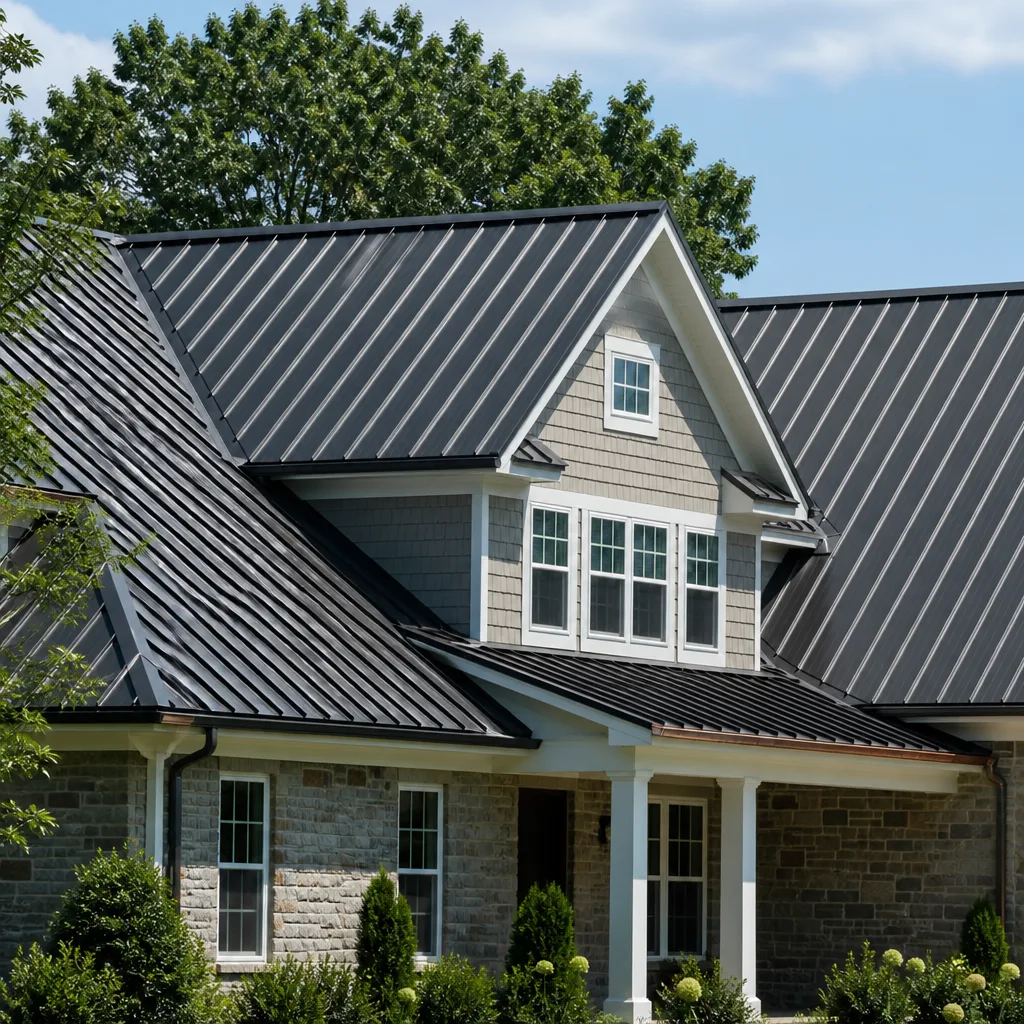 Metal roofing
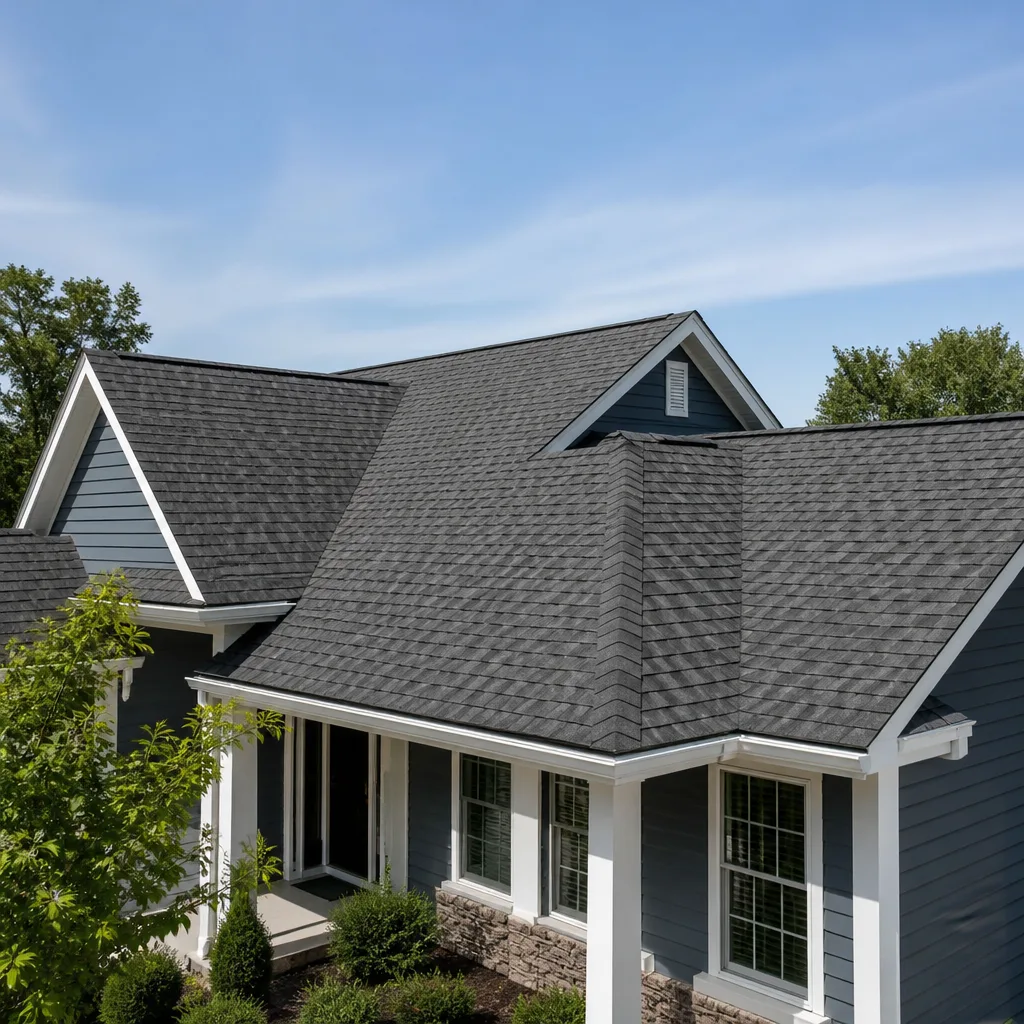 Architectural shingles
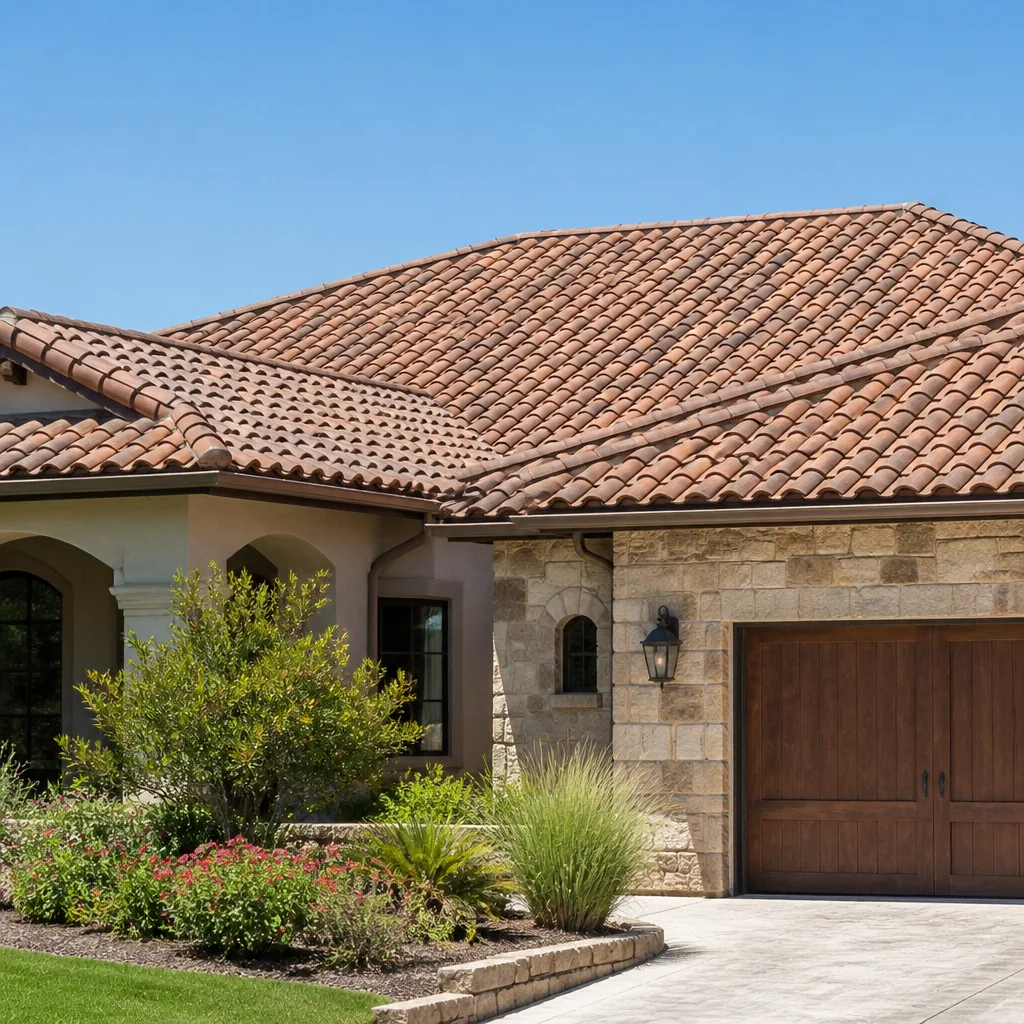 Tile roofing
 GAF
 Owens Corning
 Flat & low-slope
Free roof inspection with deck photos before we talk money - GAF and Owens Corning certified installation
Seasonal Roofing Care for Moreno Valley: Year-Round Homeowner’s Guide
Most roofing guides treat the calendar like a four-season playbook written for Vermont or Ohio. Moreno Valley averages under 11 inches of rain per year, but nearly all of it arrives in three or four concentrated storm events. That means your roof endures nine months of relentless UV and heat stress, then gets hit with sudden, heavy water load with no gradual transition to expose weaknesses first. This guide reframes your maintenance schedule around the two seasons that actually matter here: dry heat season and the pre-rainy season window. You’ll learn what to check, when to check it, and where most Moreno Valley homeowners spend money on the wrong months.
Quick Answer
In Moreno Valley, roof care should concentrate on two critical windows: late August through early October to prep for the first storms, and March through May to address heat damage before summer peaks. Skip northern-style spring cleaning and instead focus on flashing integrity, sealant condition, and drain clearing before the rainy season transition. Summer months are for ventilation checks and attic temperature management, not major exterior work.
Styles & brands we work with
Table of Contents
- The Weather Reality Most Guides Get Wrong
- The Pre-Rainy Season Window: September Through October
- Summer Heat Management: What Attic Data Actually Shows
- Santa Ana Wind Season: The Penetrations That Fail First
- What to Do Instead of Spring Cleaning
- Timing Contractor Work for Availability and Pricing
- Material Choices That Hold Up in Inland Empire Heat
- Why a Standalone Inspection Beats a Repair Estimate Every Time
The Weather Reality Most Guides Get Wrong
Moreno Valley sits in a Mediterranean climate zone with an Inland Empire twist. We get roughly 10 to 11 inches of rain annually, but the distribution is jagged. Three or four storm fronts deliver the bulk of that total, often within a six-to-eight-week span between December and March. The rest of the year is dry, hot, and increasingly windy in the fall. For your roof, this creates a unique stress profile: prolonged UV degradation of asphalt shingle binders, expansion and contraction at flashing joints, and a sudden test of every seal when the first atmospheric river arrives.
What this means practically: a roof that looks fine in August can fail in December not because of new damage, but because small compromises accumulated silently during the dry months. The heat dries out sealant around vent pipes and curbs. UV breaks down the asphalt layer, making shingles brittle. Flashing that shifted slightly under thermal cycling waits for water to find the gap. Understanding this rhythm changes how you allocate your maintenance budget. For a deeper look at how these failures show up in Moreno Valley homes, our Roof Repair in Moreno Valley page covers the most common leak sources we see after the first storm.
The Pre-Rainy Season Window: September Through October
If you do nothing else for your roof this year, do these three tasks before Halloween. The window from late September through mid-October is when daytime temperatures drop enough for sealant to cure properly, but before the first storm system typically arrives in late November or early December.
- Inspect all sealant points. Every penetration through your roof – plumbing vents, HVAC curbs, exhaust fans, and satellite mounts – relies on sealant or boot flashings that degrade under Moreno Valley’s UV load. We regularly see sealant that has pulled away from pipe flanges by the first week of October. If the caulk is cracked, chalky, or lifting at the edges, it’s time to recaulk or replace the boot.
- Clear every drain and gutter run. Sudden heavy rain on a flat or low-slope roof needs open scuppers and downspouts. Debris from the summer – dried leaves, dust from Santa Ana winds, and bird activity – accumulates in valleys and drains. A blockage during a three-inch storm event means standing water, and standing water finds seams.
- Check flashing integrity at walls and chimneys. Step flashing and counter-flashing take the brunt of thermal expansion. Look for gaps at the mortar joint, lifted flashing edges, or shifted kickout flashing at roof-to-wall transitions. These are the first points of failure in a sudden downpour.
The goal is to address weaknesses before the water test, not after. Once a leak shows up, the damage has already extended beyond whatever you see on the ceiling. If you’re unsure what to look for, our Roof Inspection in Moreno Valley service is a standalone assessment – meaning you get an honest picture of what your roof needs before committing to any repair spend.
Summer Heat Management: What Attic Data Actually Shows
Moreno Valley routinely sees summer attic temperatures above 140 degrees Fahrenheit. We’ve measured ridge-vent attics at 138 degrees on a 104-degree day, while the unventilated attic next door hit 157. That 19-degree difference isn’t trivial. Asphalt shingles degrade faster when they bake from both sides: the sun’s direct heat on top, and trapped attic heat radiating from underneath.
The data supports a few practical measures. Proper ventilation – a balance of intake at the eaves and exhaust at the ridge – reduces attic temperature meaningfully. That reduction slows the drying and cracking of shingle asphalt, extends the life of sealant at penetrations, and reduces the load on your HVAC system. The question isn’t whether ventilation matters; it’s whether your current setup moves air correctly.
For most Moreno Valley homes built before 2015, the answer is often no. Ridge vents were standard, but many builders skipped the soffit intake vents or used undersized ones. Without intake, a ridge vent pulls air from the nearest available gap – often a bathroom fan or a leaky can light. The fix is usually straightforward: verify soffit vents exist, ensure they’re not painted over or blocked by insulation, and confirm the ridge vent runs the full ridge length. This is inspection-level work, and it’s exactly the kind of assessment we do as part of a full roof evaluation before recommending any replacement.
Santa Ana Wind Season: The Penetrations That Fail First
Santa Ana winds usually arrive in late September through November, often overlapping with the pre-rainy window. Gusts in Moreno Valley can reach 40 to 55 mph in exposed areas near the hills, particularly north of the 60 and along the Perris Boulevard corridor. Wind doesn’t damage roofs evenly. It targets specific weak points, and knowing which ones matter saves you from discovering them after a shingle lands in your neighbor’s yard.
The vulnerable details in order of failure frequency:
- Ridge cap shingles. These are the first to lift in sustained wind. If the adhesive strips have dried out from summer heat, ridge caps come off in sheets. Check for curled edges or visible gaps.
- Edge metal and drip edge. Wind gets under the eave edge and pries upward. Loose drip edge creates a path for wind-driven rain later in the season.
- Pipe jacks and roof vents. Plastic static vents crack under UV exposure. When they crack, wind catches the plastic and tears the whole unit off, leaving a gaping hole.
- Lap seams on low-slope sections. Peel resistance drops with age. On modified bitumen or TPO roofs, lifting seams indicate the membrane has lost bond strength.
- Staining on the underside of roof sheathing (visible from the attic) that indicates slow leaks during the rainy season.
- Lifted or curled shingles that winter storms loosened but didn’t remove.
- Ponding areas on flat roof sections that didn’t drain within 48 hours after the last rain.
- CertainTeed Landmark and Owens Corning Duration both use polymer-modified asphalt that holds up measurably better under sustained UV than standard-grade shingles. The difference shows up as reduced granule loss and fewer cracks by year 10.
- Atlas and IKO offer strong mid-range options. Atlas Pinnacle’s Scotchgard helps with the algae that occasionally appears on north-facing slopes after wet winters.
- Lighter colors genuinely matter here. A white or light-gray shingle reflects more solar radiation, reducing attic temperature by 5 to 10 degrees compared to a charcoal roof. In Moreno Valley, that’s not an aesthetic choice, it’s a cooling bill calculation.
After a high-wind event, walk the perimeter of your home and look for shingle granules in the yard or along the downspout outlet. Granule loss concentrated in one area usually signals wind scouring, not normal wear. A professional roof inspection after a serious Santa Ana event is cheap insurance compared to a full replacement after water intrusion.
What to Do Instead of Spring Cleaning
Northern roofing guides push spring as the time for moss removal, ice dam checks, and winter damage assessment. In Moreno Valley, moss is irrelevant, ice dams don’t exist, and winter leaves little visible damage unless a storm found a weakness. So what should you do in March through May?
Shift your attention to heat preparation and post-rain assessment. If your roof survived the winter storms, March is the month to document what the water revealed. Look for:
Spring is also the right time to address ventilation before the heat arrives. In our experience, the best spring task for Moreno Valley homeowners is an attic ventilation assessment: check for blocked soffit vents, verify the ridge vent isn’t crushed, and clear any insulation that drifted over the intake points. This one action reduces summer attic temperatures more than any residential cool-roof coating ever will.
For budgeting, spring is when we see the most flexibility in material options. The full manufacturer catalog is available – whether you’re weighing Owens Corning Duration against CertainTeed Landmark or something else entirely – and the summer installation calendar hasn’t filled yet. If your roof survived winter but you know it’s aging, March through May is the time to start planning a Roof Replacement in Moreno Valley rather than waiting for a summer emergency.
Timing Contractor Work for Availability and Pricing
Moreno Valley’s roofing season peaks twice: October through December (pre-rain and rainy-season emergency work) and June through August (summer replacement projects). The shoulder windows – March through May and January through February – are when crews are scheduling the fastest and the full material menu is easiest to access.
If you’re planning a replacement, book the work in spring. The weather is mild enough for shingles to seal properly – temperature-dependent adhesive strips need ambient heat to bond, and March daytime highs in the 70s and 80s are ideal. Summer installations are fine in Moreno Valley, but attics are hotter for the crew and you’ll compete for calendar slots with homeowners who waited until the heat revealed a problem.
For repairs, the opposite logic applies: call as soon as you notice an issue, regardless of season. A minor repair in August is a fraction of the cost of a storm emergency in December. The specific scoping question is whether the repair extends the roof’s life meaningfully or just buys a season. We see homes in Moreno Valley where a $400 repair correctly extends a roof by three to five years – and other homes where a $400 patch on a 22-year-old roof is money that should have gone toward replacement. The difference comes down to an honest assessment of the deck, the underlayment, and the shingle condition, not a guess.
Material Choices That Hold Up in Inland Empire Heat
The Inland Empire’s UV index is among the highest in Southern California. What you install matters as much as when you install it. We work across seven major manufacturers – GAF, CertainTeed, Owens Corning, IKO, Atlas, Tamko, and Boral – specifically because no single brand wins every climate and budget conversation.
For Moreno Valley’s heat profile, a few material facts guide our recommendations:
The right material for your roof isn’t the most expensive one – it’s the one matched to your sun exposure, your attic ventilation, and how long you plan to stay in the home. If you’re in a Moreno Valley Ranch home with a south-facing roof and original 1990s ventilation, a premium polymer shingle in a light color will outperform a dark standard shingle by years. If you’re in a shaded Hidden Springs lot with excellent ventilation, the calculus shifts. Our roof replacement process always starts with the roof’s actual conditions, not a catalog page.
Why a Standalone Inspection Beats a Repair Estimate Every Time
Here’s the pattern we walk into constantly in Moreno Valley: a homeowner calls about a leak, a contractor quotes a repair or a full replacement on the spot, and the homeowner has to decide with no independent information. The contractor’s incentive is to sell the highest-ticket job. The homeowner’s need is to understand what the roof actually requires.
A standalone roofing inspection solves this. You pay a fixed amount for a professional assessment: the shingle condition, flashing status, ventilation setup, sheathing integrity, and the remaining life span of the existing system. What you do with that information is your call. If the finding is “repair this one flashing detail and you have five more years,” that’s the honest read. If the finding is “the deck is soft in three places and the underlayment is brittle,” replacement is the real answer – and now you know why.
We structure our work this way deliberately. The inspection comes first, with no obligation to purchase anything from us afterward. It’s the same reason we carry materials from seven manufacturers rather than pushing one brand’s program: the recommendation should follow the facts, not the other way around. If you’re not sure whether you need a repair, a replacement, or just a professional eye on the roof, start with the inspection. It’s the cheapest honest information you can buy in roofing.
Common Mistakes to Avoid
- Waiting until the first storm to check the roof. By the time water is staining your ceiling, the leak has been active for days or weeks inside the cavity. Pre-season inspection catches failures before they’re visible inside.
- Skipping the attic during summer checks. Most Moreno Valley homeowners never look at the attic side of the roof. That’s where early water stains, crushed ventilation, and heat damage show up months before exterior symptoms appear.
- Painting over soffit vents. It happens more than you’d believe in Moreno Valley: a paint crew covers the intake vents during a stucco refresh, and suddenly the attic bakes. Check yours aren’t sealed over.
- Assuming a “40-year shingle” lasts 40 years here. In the Inland Empire’s UV environment, a 40-year-rated shingle realistically performs for 22 to 28 years. The rating assumes milder solar conditions. Plan for the local reality, not the warranty brochure.
- Replacing a roof without fixing the underlying ventilation. A new roof over a bad attic ventilation setup just bakes the new shingles faster. The roof and the ventilation work as a system, not two separate decisions.
- Treating all leaks as roof failures. In flat and low-slope sections common on Moreno Valley condo and commercial buildings, leaks often trace to drain blockages or sealant failure at curbs, not the membrane itself. Repair the actual source, not the symptom.
See the difference
 Before
 After
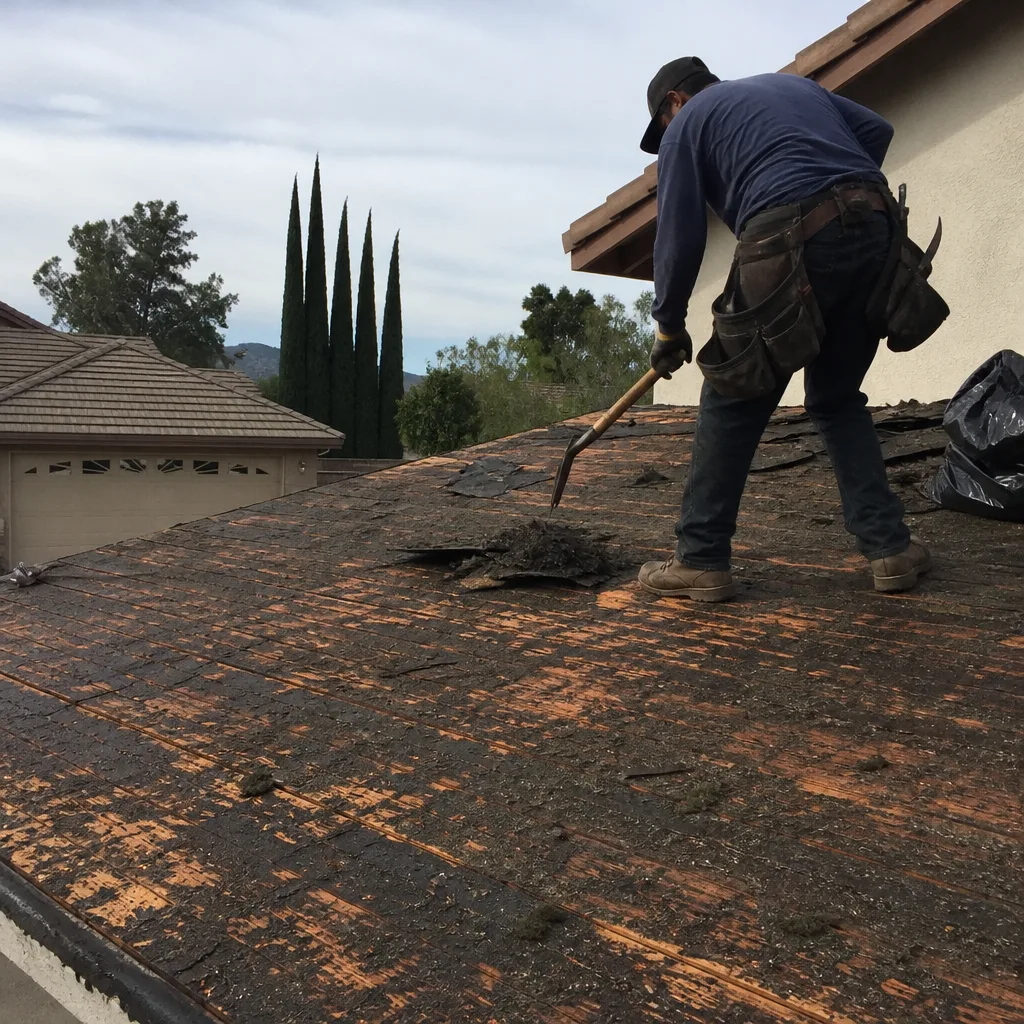 Before
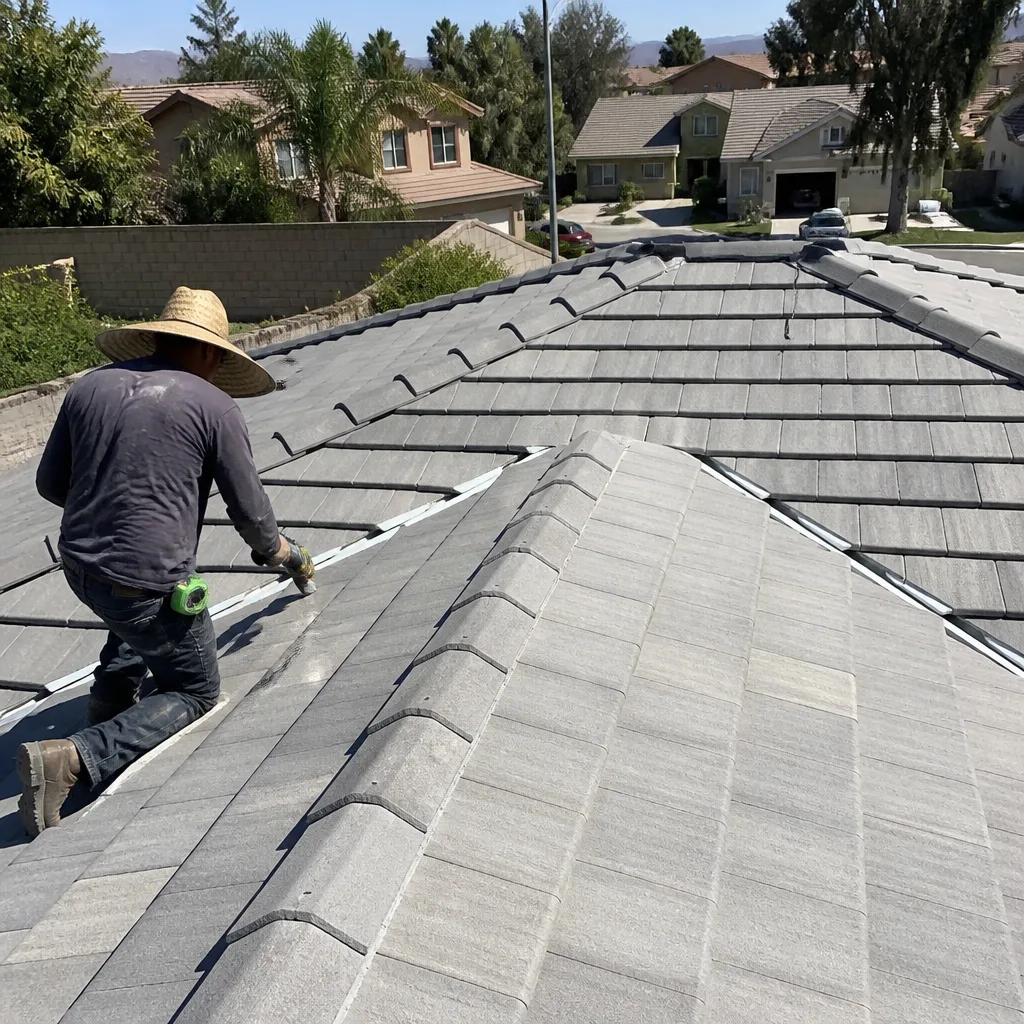 After
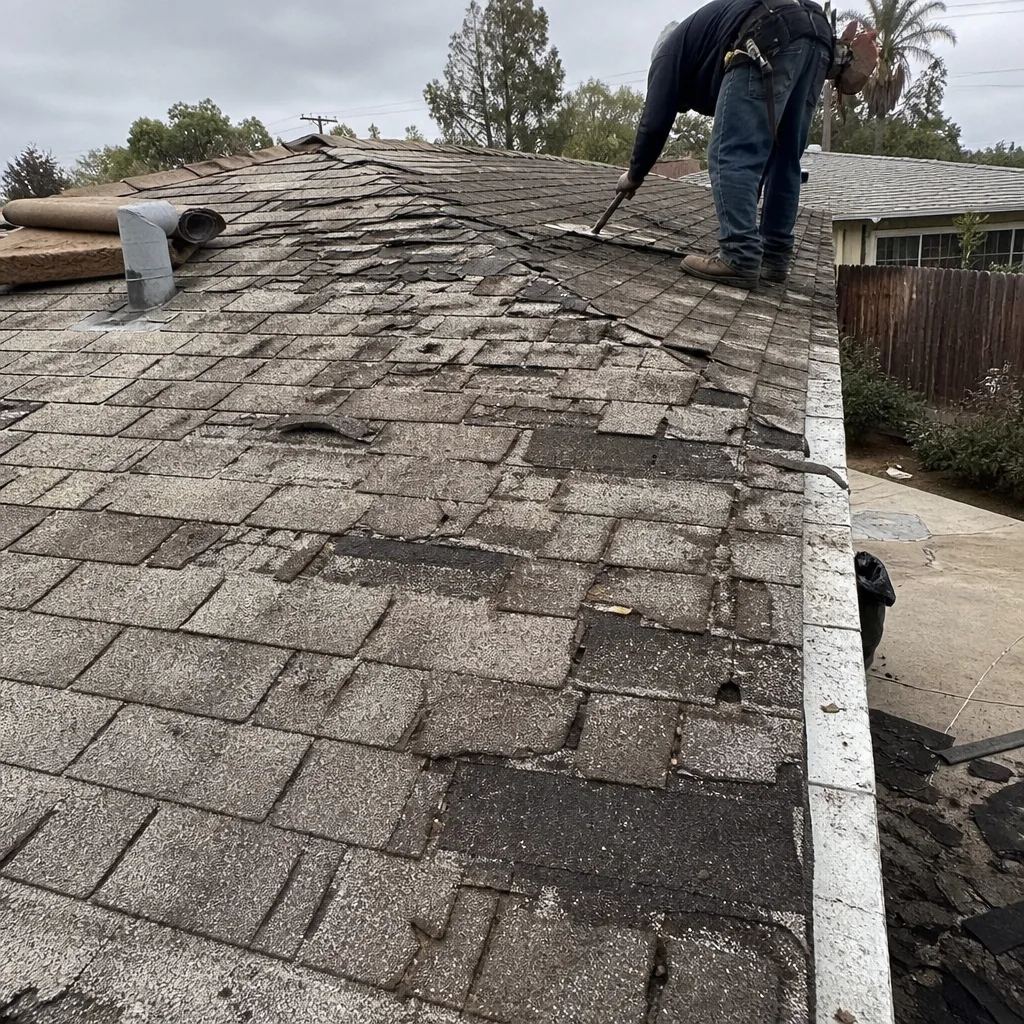 Before
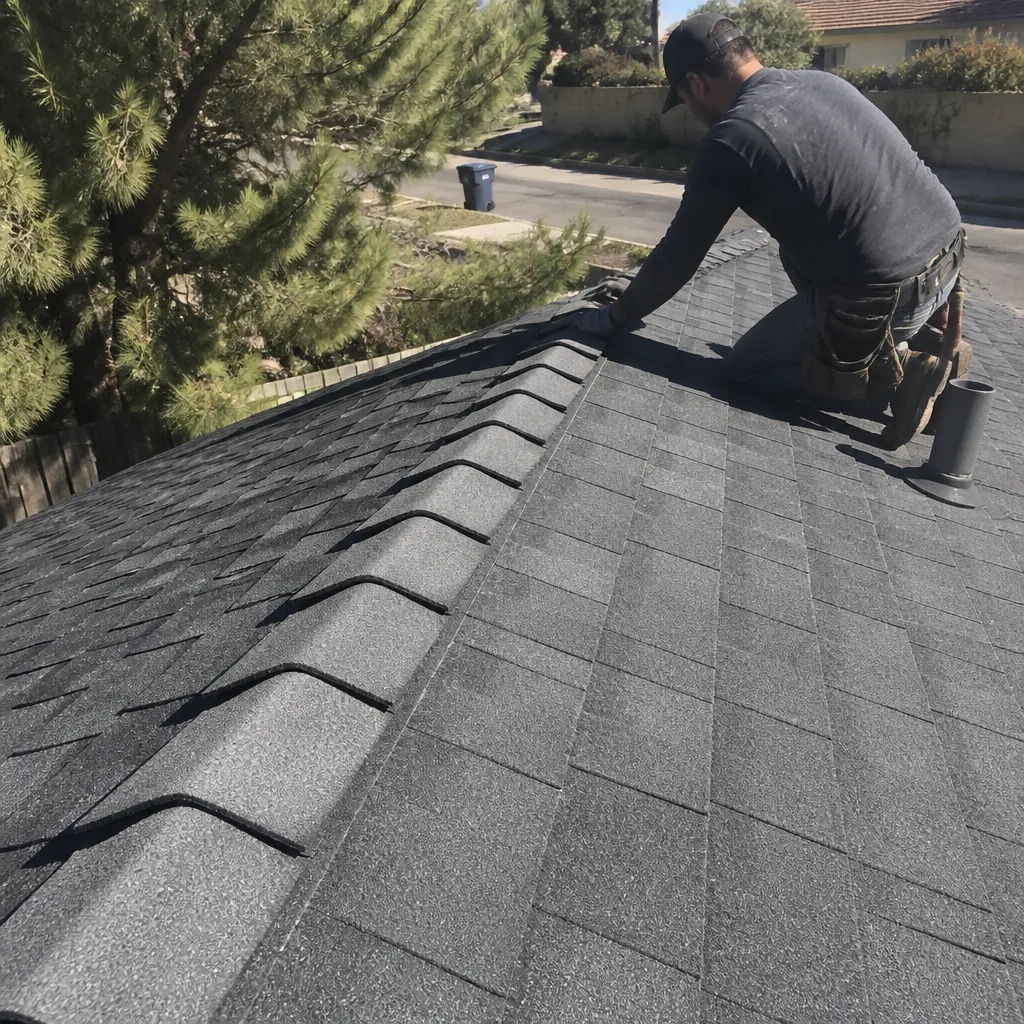 After
When to Call a Professional
Some roof conditions are safe to observe from the ground or from a ladder at the eave edge. Others are not. If you see granule loss concentrated in a channel, shingles lifted along the ridge, or water stains in the attic, it’s time to bring in someone who can safely walk the surface and assess the deck below. Working on a roof involves genuine fall risk, and heat-weakened shingles can be slippery or brittle. Don’t climb past the eave on your own.
If a storm has exposed underlayment, if you see daylight from inside the attic, or if three or more shingles have come loose in one area, get a professional evaluation before the next weather system. Moreno Valley Roof Repair offers free estimates in Moreno Valley – call (866) 217-3967 to schedule one.
Frequently Asked Questions
Once a year, ideally in September or early October before the rainy season begins. This catches UV-damaged sealant and wind-lifted flashing before the first storm tests them. After any major Santa Ana wind event or a storm that produces visible granule loss in the yard, a focused inspection is worth scheduling regardless of the calendar. Call (866) 217-3967 to set up a standalone inspection with no obligation to purchase anything further.
Roof repair in Moreno Valley typically runs between $350 and $1,800 depending on the scope. A simple pipe boot replacement or a small flashing repair sits at the low end. Multiple penetration recaulks, a section of ridge cap replacement, or a localized membrane patch land higher. The only way to price it accurately is to see the failure in person, which is why our estimate process starts with a visual inspection. Call (866) 217-3967 for an exact quote – estimates are free.
Not if the inspection was done properly. Where prices shift on roofing work is when the original quote was based on a quick ground-level look and the crew discovers deck rot or additional damage once the shingles come off. We avoid this by inspecting the attic side and checking the deck condition before quoting. If we tell you a number, that’s the number – unless you approve a change order in writing first.
For full roof replacement in Moreno Valley, yes – the city requires a building permit and an inspection after the work is complete. For repairs below a certain threshold (usually a few hundred square feet or fewer), permits are typically not required. We handle the permit pull and coordinate the required inspections as part of any replacement project, so you don’t manage that process yourself.
A standard single-family shingle replacement in Moreno Valley takes 2 to 4 days of active work, weather permitting. Complex roofs with steep pitches, tile, or multiple levels run longer. The permitting process adds lead time before the job starts, so if you’re planning a replacement, begin the conversation 3 to 6 weeks before you want materials stacked.
Polymer-modified asphalt shingles in light colors are the sweet spot for most Moreno Valley homes. CertainTeed Landmark and Owens Corning Duration both offer polymer blends that resist UV degradation better than standard shingles, and lighter colorways reduce attic heat gain. Tile and standing seam metal handle the heat well too, but they come at a higher upfront cost that doesn’t always pencil out for a standard suburban lot. The right answer depends on your sun exposure, ventilation, and how long you’ll stay in the home – a conversation we’re happy to have based on your actual roof, not a catalog.
The Bottom Line
Moreno Valley’s roof care calendar runs on two seasons, not four. Prep for the winter storms in September and October, manage heat and ventilation from spring through summer, and treat Santa Ana wind events as their own inspection trigger. Skip the northern-style spring cleaning rituals and spend that time on attic ventilation, post-rain assessment, and planning any replacement for the mild spring window when crews are available and every material option is on the table. The single best move you can make is a standalone inspection before you spend on any repair or replacement – it tells you what your roof actually needs, not what someone wants to sell you.
Get Your Seasonal Roof Assessment in Moreno Valley
You don’t need to guess which season your roof needs attention. We’ll walk the surface, check the attic, and tell you exactly what’s going on – whether that’s a simple repair, a full replacement, or just confirmation that you’re good for another year. Reach out to schedule your inspection or discuss a maintenance plan that fits Moreno Valley’s actual weather patterns.
Call (866) 217-3967 for a free estimate, or visit our Moreno Valley Roof Repair home page to learn more about how we approach roofing work in the Inland Empire.
Written by the team at Moreno Valley Roof Repair, serving Moreno Valley since 2013.